



Red Bank packs about 12,900 people into 2.15 square miles, making it one of the densest municipalities in Monmouth County. It has a real downtown — theaters, restaurants, a train to Manhattan, apartments above storefronts — and it has the move-day headaches that come with a real downtown.
Most of those headaches are solvable. All of them are worse if you discover them on the morning of.
Here’s what we tell every Red Bank customer before we put a date on the calendar.
The Broadwalk closure: check your dates first
This is the one that surprises people every single year.
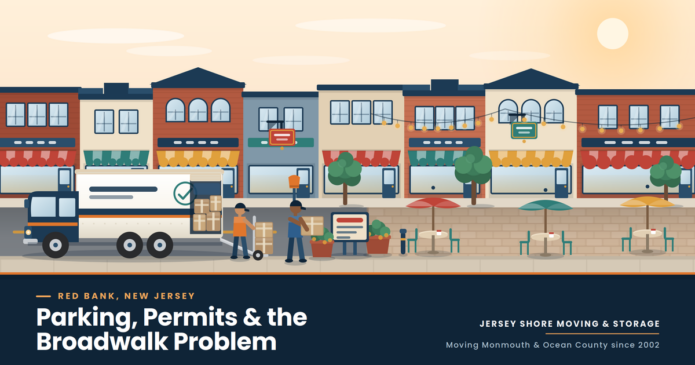
Red Bank closes the northern stretch of Broad Street to vehicles for the outdoor dining season — the “Broadwalk.” In 2026 it ran roughly mid-May through September 30, and the borough now treats it as settled policy rather than a pilot program. 2026 was its seventh year.
If your building’s address or its only practical loading access is on that stretch of Broad Street, a summer move is a fundamentally different job than a winter one. Not impossible — but it means staging the truck elsewhere, longer carries, and a realistic conversation about crew size.
Action item: before you sign a lease or set a closing date for a downtown Red Bank address, look at where the truck will actually park in May through September. Then confirm the current year’s Broadwalk footprint with the borough, because the exact blocks and dates can shift year to year.
Parking and permits: what Red Bank actually requires
We dug into Red Bank’s ordinances for this, and the picture is more specific in some places and less specific in others than you’d expect.
Dumpsters and storage containers on the street require a permit. This is clearly codified. The permit is issued by the Traffic Safety Officer at the Red Bank Police Department, and the fee structure is $50 for the first 15 days and $100 for each additional 15-day period. The officer can attach safety conditions. If you’re planning a POD-style container or a dumpster for a downtown cleanout, this is your first call.
Permit parking zones exist, including the White Street lot. Permit zones operate 8 a.m. to 6 p.m., Monday through Friday, and cover the White Street lot along with Gold Street, Mechanic Street/Linden Place, Globe Court, Morford Place, and Union Street. Permit fees run $180 for 30 days, $275 for three months, and $500 for six months.
Street excavation is a separate permit — $100 per opening plus $150 inspection and a performance bond, through the Director of Public Utilities. That covers digging, not temporarily occupying a curb.
Here’s the honest gap: we could not find a documented process in Red Bank’s ordinances for a moving truck permit, a temporary no-parking reservation, or meter-bagging to hold curb space for a move. That doesn’t mean nothing can be arranged — it means there’s no published form or fee we can point you to. Call the RBPD Traffic Safety Officer and ask directly. Any mover who quotes you a specific “Red Bank moving permit fee” without that call is making it up.
Borough resources worth bookmarking: the Parking page, Parking Permits, and Permit Information.
Downtown apartment moves: the walkable-downtown tax
Red Bank’s downtown is genuinely walkable, which is why people love living there and why moving there costs more than moving into a suburban ranch of the same size.
The variables that drive a downtown Red Bank quote:
Carry distance. If the truck can’t get within 30 feet of your door, every single item takes longer. This is the largest hidden cost in dense-downtown moves, and it’s the one most often left out of a phone estimate.
Stairs and stairwell geometry. Older mixed-use buildings weren’t designed around furniture logistics. Turns, landings, and doorway widths matter more than total flight count. Measure your largest piece — sofa, mattress, armoire — and measure the narrowest turn it has to make.
Elevator access and building requirements. Newer multifamily buildings usually require a certificate of insurance from your mover naming the building, and often a reserved elevator window. Ask your property manager what they need in writing and forward it to your mover at least a week out. If a mover can’t produce a COI on request, that’s disqualifying.
Red Bank’s downtown residential supply is growing, too — The Commodore at 176 Riverside Avenue is bringing roughly 210 units online, and there’s a proposed train-station-area plan in the several-hundred-unit range. Newer buildings tend to have better loading logistics than 1920s walk-ups, but stricter paperwork.
The commuter angle — and a 2026 cost change worth knowing
Red Bank station sits on NJ Transit’s North Jersey Coast Line at Bridge Avenue between Monmouth and Oakland Streets. Manhattan is roughly 75 to 90 minutes door to door.
One material change: station parking fees rose sharply effective January 15, 2026 — the annual commuter permit went from $480 to $1,008, and the daily rate from $4 to $6. Weekends and weekday parking after 11 a.m. remain free.
That’s not a moving cost, but it’s a real line item if you’re relocating to Red Bank specifically for the train, and it’s worth factoring into the “can I afford this neighborhood” calculation alongside rent.
Scheduling around a downtown that’s always busy
Red Bank hosts things. That’s part of the appeal, and part of the problem.
The Guinness Oyster Festival takes place in the White Street parking lot at 19 White Street — which means the borough’s most useful downtown lot is out of service that weekend. The weekend farmers market runs Sundays at the Galleria lot, West Front Street and Shrewsbury Avenue. Count Basie Center for the Arts and Two River Theater generate evening traffic and fill parking on show nights.
Practical scheduling rules for Red Bank:
- Check the borough events calendar before you pick a date. Not after.
- Start early. A 7 a.m. arrival gets you loading before downtown wakes up. By 10 a.m. on a Saturday, every curb is contested.
- Avoid Saturdays in season if you have any flexibility. A Tuesday move in downtown Red Bank is a different, easier day than a Saturday move.
- Month-end and the first of the month are lease-turnover crunch. If you’re renting, you may not have a choice — but book six-plus weeks out if that’s your situation.
What a Red Bank move costs
New Jersey statewide 2026 benchmarks put local moving around $131–$135 per hour on average, with 2–3 mover crews roughly $150–$275 per hour, and typical three-bedroom local moves in the $1,100–$2,600 range.
Downtown Red Bank tends to sit toward the higher end of comparable-size moves, for the reasons above: carry distance, stairs, elevator scheduling, and constrained truck access. A one-bedroom apartment move in a walk-up with a 200-foot carry can genuinely take longer than a two-bedroom house with a driveway.
New Jersey requires a survey and a written, itemized estimate marked binding or non-binding at least 24 hours before your move. For a downtown move, insist the survey includes where the truck will park. That single question separates movers who know Red Bank from movers who know how to answer a phone.
Also: New Jersey’s default mover liability is $0.60 per pound per article. Ask about additional valuation coverage before move day.
Hiring in Red Bank: verify, then ask
Look up any New Jersey mover’s license at the Division of Consumer Affairs’ Regulated Business portal — rgbportal.dca.njoag.gov/public-view. Licensed public movers hold PM, PW, or PC license prefixes. NJ has required this for intrastate moves since 1999.
Then ask: Can you provide a COI naming my building? Have you moved in this part of downtown before? Where will the truck park? Is the crew yours or subcontracted?
Jersey Shore Moving & Storage has served Monmouth County since 2002. We’re a National Van Lines agent, BBB accredited with an A+ rating, we run our own crews, and we maintain climate-controlled warehouse storage in Ocean County — useful when your Red Bank lease start date and your closing date don’t line up.
Next step: request a free quote or call 732-295-9988. Tell us your building, your floor, and whether elevator access exists. We’ll tell you honestly what the day looks like.
Frequently Asked Questions
Do I need a permit to park a moving truck in downtown Red Bank? Red Bank’s published ordinances don’t include a specific moving-truck permit or temporary no-parking reservation process. Dumpsters and storage containers placed on the street do require a permit from the Police Department’s Traffic Safety Officer ($50 for the first 15 days, $100 per additional 15 days). For curb access on move day, call the Traffic Safety Officer directly and ask what they’ll authorize.
Is Broad Street closed to cars in the summer? Yes. The northern stretch of Broad Street closes to vehicles for the Broadwalk outdoor dining season, running roughly mid-May through September 30 in recent years. Confirm the current year’s blocks and dates with the borough, and factor a longer carry into any summer move on that stretch.
What does my Red Bank apartment building need from my mover? Most newer buildings require a certificate of insurance naming the building as additional insured, and many require a reserved elevator window. Ask your property manager for their requirements in writing and send them to your mover at least a week before move day.
How much does it cost to move into a downtown Red Bank apartment? Expect the higher end of the range for your home size. New Jersey 2–3 mover crews run roughly $150–$275 per hour; downtown moves add time for long carries, stairs, and elevator scheduling. Get a written estimate that specifically addresses truck parking.
Did Red Bank train station parking get more expensive? Yes. Effective January 15, 2026, the annual commuter parking permit rose from $480 to $1,008 and the daily rate from $4 to $6. Weekends and weekdays after 11 a.m. remain free.